The Alchemists at the Tap: Meet the Scientists Turning Beer Into Something Entirely New
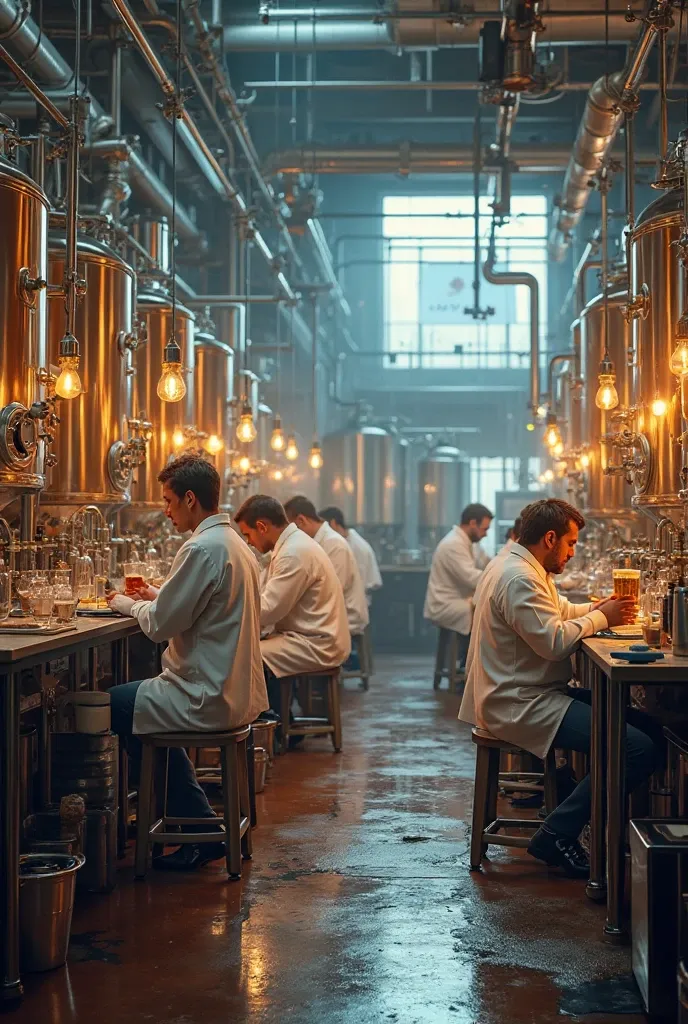
Photo: craft brewer scientist laboratory beer fermentation equipment closeup, via image.cdn2.seaart.me
Mara Solis spent three years studying food microbiology at UC Davis before she ever pulled a commercial pint. Her thesis involved the flavor-active compounds produced by wild yeast strains under thermal stress — not exactly the stuff of bar conversation. But stand next to her while she's building a recipe, and you start to understand that everything she learned in that lab is alive in every decision she makes at the fermentation vessel.
"Most brewers think about ingredients," she says, leaning against a stainless tank at her small production facility outside Portland. "I think about what those ingredients are doing to each other at a molecular level. That's a different starting point."
Solis is part of a growing cohort of American craft brewers who came to the industry not through homebrewing tradition or a family taproom, but through the hard sciences. Chemists, microbiologists, food scientists, flavor technologists — they're arriving in brew houses with a different set of questions, and the beers coming out of their tanks are unlike anything the craft movement has produced before.
Credentials on the Mash Paddle
The pipeline from science program to brewery isn't entirely new. The technical side of brewing has always required a working knowledge of chemistry and biology, and the Siebel Institute and UC Davis brewing programs have long attracted analytically minded students. But something has shifted in the last several years. The people coming in now aren't just using science to make traditional beer more consistently. They're using it to make beer that traditional brewers would find baffling.
Take Jordan Fitch, who spent a decade working in pharmaceutical flavor masking before pivoting to craft brewing in Chicago. His background involved engineering compounds that could suppress bitter pharmaceutical tastes — work that required an almost obsessive understanding of how the human palate processes bitterness, sweetness, and astringency simultaneously. He brought that knowledge directly to the brew house.
"Bitterness in beer is so much more complex than most people give it credit for," he explains. "There are dozens of distinct bitter compounds, and they each land differently on the tongue, they each linger differently, they each interact differently with carbonation and fat and protein. I got to spend ten years mapping all of that. Now I get to play with it."
The results are beers that manipulate perceived bitterness in ways that feel almost architectural — IPAs that hit aggressively up front and then vanish cleanly, stouts where roast bitterness and sweetness trade places across the finish in a way that feels choreographed.
Fermentation as a Flavor Engine
If water is the overlooked ingredient in brewing, fermentation is the misunderstood one. Most drinkers know that yeast turns sugar into alcohol, and most casual craft enthusiasts understand that different yeast strains produce different flavor profiles. But the science-trained brewers operating at the edge of the field are working with fermentation in ways that feel less like brewing and more like cooking with invisible fire.
Amy Cho, a microbiologist-turned-brewer based in Asheville, North Carolina, has spent the last four years building a library of wild yeast strains isolated from the Blue Ridge Mountains. Each strain has been characterized in her lab — not just for flavor output, but for temperature sensitivity, attenuation curves, and interaction with specific sugar compositions. When she builds a recipe, she's essentially casting a yeast the way a director casts an actor: for a specific role, in a specific environment, to produce a specific effect.
Her current project involves a series of farmhouse-style ales fermented with strains isolated from different elevations along a single ridgeline. The flavor differences between batches are subtle but documentable — slight shifts in ester character, varying levels of phenolic spice, different rates of carbonation development. To most drinkers, they taste like variations on a theme. To Cho, they're a longitudinal study in microbial terroir.
"I'm not trying to make the same beer better," she says. "I'm trying to ask questions that beer hasn't been asked to answer before."
Ingredients That Have No Business Being in Beer
The ingredient lists coming out of these science-forward breweries read less like a recipe and more like a research proposal. Koji — the mold culture that underpins sake, miso, and soy sauce production — has become a particular obsession for brewers with food science backgrounds. Applied to grain before mashing, koji produces a suite of enzymes and flavor precursors that fundamentally alter the character of the finished beer, adding umami depth and a kind of savory roundness that hops and malt alone can't manufacture.
Fitch has been working with koji-treated barley for two years. His current release, a hazy ale built on a koji-modified grain bill and dry-hopped with a single experimental variety, has been described by tasters as tasting like "a beer that ate a really good meal." He takes that as a compliment.
Elsewhere, brewers are experimenting with enzymatic modification of lactose to create novel fermentable sugars, using centrifuge technology borrowed from winemaking to clarify beers without fining agents, and applying sous vide techniques to hop additions to extract specific aromatic compounds while leaving others behind. The line between brew house and culinary lab has effectively dissolved.
The Authenticity Question
Not everyone is enthusiastic. The craft beer community has a complicated relationship with innovation — it celebrates experimentation in the abstract while occasionally turning suspicious when the results feel too far removed from the thing it fell in love with. A beer brewed with koji and fermented with mountain-isolated wild yeast and finished with centrifuge clarification is, technically, still beer. But it sits at the edge of a definition that some drinkers feel protective of.
The science-trained brewers tend to find this tension interesting rather than threatening. Solis points out that virtually everything considered traditional in modern brewing was, at some point, a radical departure from what came before. Refrigeration. Cultivated yeast. Pelletized hops. The history of brewing is a history of technology reshaping tradition, and the current moment is just a more self-conscious version of a very old story.
"The craft beer community built its identity on pushing back against the industrial," she says. "I'm pushing back against the conventional. That feels like the same spirit to me."
What It Tastes Like to Drink a Question
There's a particular experience that comes with tasting beers made by people who approach the craft as a research problem. The flavors arrive in unexpected sequences. Familiar reference points — the roast of a stout, the citrus of a pale ale — appear and then reveal themselves to be doing something slightly different than you expected. You find yourself paying attention in a way that a more conventional beer doesn't require.
That heightened attention is, arguably, the whole point. These brewers aren't trying to make beer that goes down easy. They're trying to make beer that earns its place in a conversation about what flavor can do, what fermentation can build, and what happens when someone with a deep scientific education decides that the most interesting place to apply it is inside a pint glass.
The alchemists are at the tap. What they're pouring is worth your full attention.