Holy Ground: The American Breweries Worth Crossing State Lines to Visit
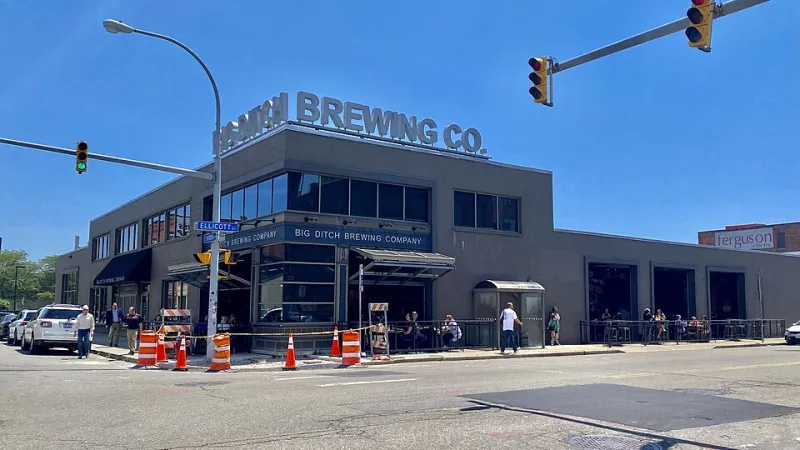
Photo: Andre Carrotflower, CC BY-SA 4.0, via Wikimedia Commons
There's a difference between a brewery you enjoy and one you'd drive eight hours to reach. Most places fall into the first category. A small, almost inexplicable handful fall into the second — and the people who've made those drives will tell you the beer was only part of the reason they went.
Call it atmosphere. Call it history. Call it the cumulative weight of a place that's been doing one thing exceptionally well for long enough that it starts to feel like something larger than itself. Whatever you call it, certain American breweries have crossed a threshold from business into something closer to destination — the kind of spot that gets added to bucket lists, inspires coordinated pilgrimages among friend groups, and earns the kind of loyalty that makes grown adults tear up a little when they finally arrive.
We wanted to understand what actually creates that feeling. So we talked to brewmasters, regular visitors, and a few people who've built entire road trips around a single taproom visit. Here's what we found.
It Starts With the Land
Geography does more work than most people realize. The breweries that feel genuinely sacred tend to be deeply embedded in a specific place — not just located there, but shaped by it.
Hill Farmstead Brewery in Greensboro Bend, Vermont sits at the end of a long dirt road in the Northeast Kingdom, one of the most remote corners of New England. There's no signage. There's no tourist infrastructure. You either know where it is or you don't find it. Founder Shaun Hill has spoken openly about the land being inseparable from the beer — the water, the elevation, the isolation. Visitors describe the experience of arriving as something between a reward and a revelation. The drive is part of the ritual.
Out west, Russian River Brewing in Santa Rosa, California occupies a different kind of geography — a downtown taproom that's become a pilgrimage site largely because of what happens inside it. But even here, place matters. Northern California's brewing culture, its proximity to world-class hop and barley growing regions, its particular brand of laid-back intensity — all of it is present in the glass.
The breweries that feel like more than breweries tend to know where they are. They don't fight their surroundings. They absorb them.
History as Architecture
Age alone doesn't create reverence, but it helps. When a brewery has been operating long enough to outlast trends, absorb setbacks, and accumulate stories, it starts to carry a kind of weight that newer operations simply can't manufacture.
Anchor Brewing in San Francisco — before its heartbreaking closure in 2023 — was perhaps the clearest example of this. Founded in 1896, revived by Fritz Maytag in the 1960s, it became the godfather of the American craft beer movement. Visiting Anchor wasn't just drinking beer. It was touching a lineage. The loss of that physical space still stings for people who made the trip specifically to stand in a room where American craft brewing was essentially invented.
Yuengling in Pottsville, Pennsylvania carries similar weight — the oldest operating brewery in the country, with a cave system beneath the building that dates to the 1800s. The tours are modest by modern standards. The experience is not. There's something about standing in a space that has continuously made beer since 1829 that recalibrates your relationship to the drink in your hand.
These places remind you that craft beer isn't a recent invention. It's a recovery.
Community as Congregation
Every great pilgrimage site has its congregation, and the breweries that feel most sacred tend to have cultivated communities that are genuinely distinct — people who share a language, a set of values, a way of approaching the experience that goes beyond showing up and ordering a pint.
Three Floyds Brewing in Munster, Indiana has built one of the most devoted followings in American craft beer, anchored in part by Dark Lord Day — an annual release event that draws thousands of people from across the country for a single beer. It's loud, it's chaotic, it's nothing like the hushed reverence of a Vermont hillside taproom. But the devotion is the same. People plan months in advance. They travel in groups. They treat it like a holiday.
That communal dimension is something brewmasters increasingly understand as central to what they're building. "The beer is the reason people come the first time," one Midwest brewer told us. "But the people are the reason they come back. You can't separate the two."
The taproom, at its best, functions like a gathering place with a specific theology — a shared agreement about what matters, what's worth paying attention to, what deserves a moment of honest appreciation.
What Makes the Drive Worth It
We asked a dozen people who'd made significant trips specifically to visit a brewery what they remembered most. Almost none of them led with the beer.
They talked about the light coming through the windows at Allagash in Portland, Maine on a late afternoon in October. They talked about the smell of the barrel warehouse at Goose Island in Chicago. They talked about a conversation they had with a stranger in line at Pliny the Younger's annual release, or the moment they stepped onto the patio at Dogfish Head in Milton, Delaware and felt, for reasons they couldn't fully articulate, like they were exactly where they were supposed to be.
The beer was good. The beer was often great. But the experience — the specific, unrepeatable combination of place, people, history, and intention — was what made it holy.
That's the thing about pilgrimage. You don't travel that far just for a product. You travel because you believe the experience of being in a particular place will change something in you, however slightly. The best American breweries understand this, whether or not they'd use that language to describe it.
They're not just making beer. They're tending to a space where something real can happen.
Plan Your Own Route
If you're building a beer pilgrimage of your own, a few principles from the people who've done it:
Go on a weekday if you can. The breweries worth traveling to are almost always worth experiencing without the weekend crowds. The conversations are better. The pace is slower. You get more of the place.
Skip the flight, take the drive. The journey is part of the experience. Arriving somewhere after eight hours on the road is a different thing than stepping off a plane. You've earned the beer differently.
Talk to the people who work there. The staff at destination breweries tend to be genuinely knowledgeable and genuinely passionate. Ask them what they're excited about. Ask them what their favorite thing on the menu is. You'll almost always learn something worth knowing.
Give yourself time to sit. Don't rush. The breweries that feel sacred are the ones that reward stillness. Order something, find a seat, and let the place settle around you before you reach for your phone.
The glass in front of you has a story. So does the room you're sitting in. Both of them are worth paying attention to.